

TL;DR
A timeout does not prove an email failed. Give each intended send a stable identifier, reuse it only for retries of that same request, and check your provider’s duplicate-protection limits. When complaints arrive, review each customer’s recent email history across campaigns and automations. Look for exact duplicates and similar messages that add little value. Test one controlled retry before changing production behavior.
Identify the send, not the attempt
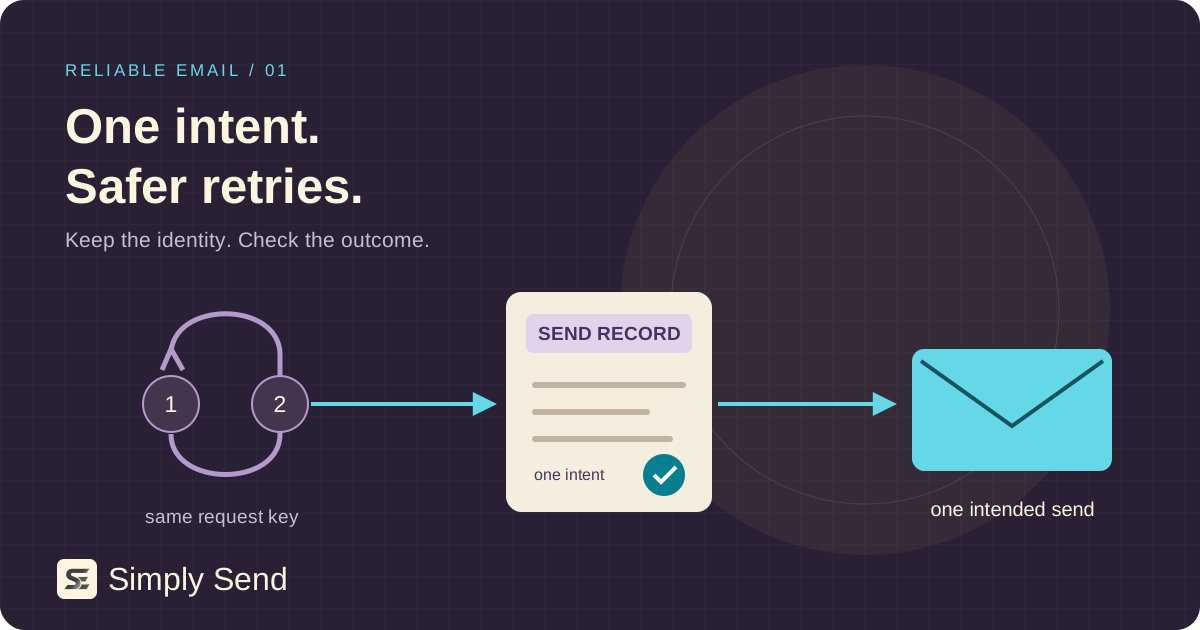
Idempotency means repeating an operation without creating an additional effect. For email requests, an idempotency key tells a supporting service that another attempt belongs to the same intended send.
Create and persist that identifier before dispatch. For a hypothetical receipt, save a UUID alongside the order event and recipient. Reuse it with unchanged request parameters after a timeout; generating a new key for every attempt defeats duplicate protection. A genuinely new notification needs its own identity.
Check the protection’s limits
Protection has boundaries. Check the sending interface, retention window, and concurrent-request behavior before relying on a key. HTTP standards caution against automatically retrying a non-idempotent request unless you know it is safe.
Keep a durable local record connecting the business event, intended recipient, request identity, and provider message ID when available. If acceptance remains uncertain and duplicate protection has expired or is unavailable, reconcile the outcome rather than blindly replaying it. Follow documented retry guidance with bounded attempts and delays. None of this guarantees inbox placement.
Complaints? Review recent messages
Investigate the customer’s recent email history across every sending tool: product notifications, campaigns, reminders, and manual sends. Count messages in the relevant period, compare timestamps and event IDs, and check which content actually reached them when evidence is available. An API attempt alone is not proof of receipt.
Look beyond exact duplicates. Different campaigns can repeat the same offer, or an automation can repeat advice without adding value. These patterns may contribute to complaints even when every request has a different key. Treat them as hypotheses, not proof of a complaint’s cause.
Review consent, expected frequency, and opt-out handling too. Google’s sender guidance emphasizes subscribed recipients and recipient feedback. As an editorial recommendation, pause the offending workflow while investigating confirmed repetition; avoid reproducing private message content in broad logs.
Test one retry deliberately
Use a test recipient you control. Repeat one unchanged request with the same key, compare responses and send records, then verify the mailbox separately. Document the expiry boundary. Finally, review overlapping campaigns: request deduplication cannot decide whether two distinct messages were useful to the reader.
Set it on Simply Send
For the transactional send API and marketing send API, set the optional Idempotency-Key HTTP header to your saved UUID. For SMTP, add it as a message header. Reuse the same value only for the same send. The guides document 24-hour duplicate protection and in-progress responses. When uploading transactional attachments separately, use the same key for the attachment request and send request.